This page is intended to help homeowners to:
- understand the importance of the Livable Housing Design Guidelines (LHDG)
- decide on which level of the LHDG to implement
- be aware of extra features to maximise the benefits of LHDG
What is livable housing?
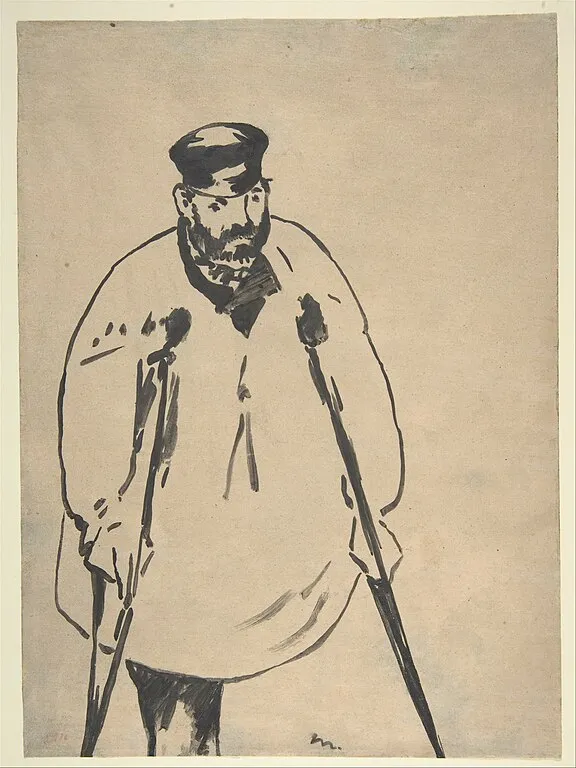
‘Man on crutches‘ by Édouard Manet 1878
Livable housing is a set of features that make your home easier to live in if you have mobility issues. Examples of these features include; wider doors and corridors, a hobless shower, handrails in the shower and toilet, a stepless entry and access path. In most situations these are easily included in a new home or extension at little or no extra cost. They form a critical element of a house suitable for aging in place. They are also excellent insurance in the event you have a serious accident. If you have comprised mobility these features will really matter!
My lived experience
In September 2024 I had a minor cycling accident that resulted in a fractured hip. I had surgery to pin the fracture. As soon as I could manage crutches and two stairs I was discharged from hospital. Going home was a stark reality-check into the importance of accessibility and universal design. The shortcomings of my older two-story house became very apparent. With my injury, stairs presented a significant and painful challenge. As my recovery progressed, I reflected on how my house could have been better prepared for my sudden unexpected incapacity. This is not just my professional advice; this comes from my painful lived experience.
The Livable Housing Design Guidelines (LHDG)
The LHDG is an Australian best practice standard that provides a common language for the design and construction of livable housing. The guidelines are easy to understand and are practical. They should be your starting point for specifying livable housing features.
The LHDG has the following core elements:
- A continuous step-free path from the street or parking area to the dwelling entrance
- A step-free entrance into the dwelling
- Internal doors and corridors that facilitate easy movement between rooms
- An easy to access toilet on the entry level
- A bathroom with a hobless shower
- Reinforced walls in the toilet, shower and bath to support the installation of grabrails
- Stairs that are designed to reduce the likelihood of injury
The LHDG has three levels; Silver, Gold and Platinum. Silvers details a set of basic accessibility features. The higher levels substitute the basics with features that make things easier for someone with compromised mobility. Before reading further you should take the time to become familiar the Livable Housing Design Guidelines.
Silver level
This level covers only the very basic liveable house elements. It’s a great start but a house at this level may not be comfortable if you have acute or ongoing mobility issues. You should only specify ‘Silver’ in situations where space is limited.
To muddy the waters, the National Construction Code (NCC) Livable Housing Design Standard also includes various livable housing design elements. These mostly duplicate the features of the Silver level. In the ACT new houses and extensions are required to meet this part of the NCC. As a result, your new build in the ACT will get basic Silver features. In NSW houses are not required to meet this part of the NCC. So it’s important that you specify at least Silver as a requirement for your project.
Gold level
This is the minimum level I would recommend. It is easy to implement and achieves a good balance between cost and accessibility. As a bonus the generous corridor widths and larger doors will help your home to feel spacious.
Platinum level
You should use Platinum for multi-generational family homes or for a house where you are planning for aging in place. The larger shower will be important for older people with significant and ongoing mobility issues.
Two-story houses & LHDG
It is important to note that LHDG does not require the key livable house features to be on the same floor or next each other. It’s possible to have the toilet on the ground floor and the shower on the second floor separated by stairs. There is also no requirement to have the compliant toilet or showers on the same floor as a living area or bedroom. Having to use stairs to move between these rooms would significantly compromise the suitability of a house for someone on crutches or using a walking frame.
Feature in addition to the LHDG
Based on my personal experience, I would implement the following additional features.
Fit the handrails in the shower and toilet before you need them
The LHDG only requires the walls to be reinforce and ready for fitting handrails. Consider fitting the handrails during construction so they are there if you unexpectedly need them. If you are seriously injured the last thing you need to be worrying about is “I better get those handrails sorted so I can use the toilet when I get home”!
Split level and two-story houses
For this type of layout your goal should to be eliminate or minimise the need to use stairs to access the main areas of the house.
If you are planning for aging in place, then it is important that all of the spaces you would need to live comfortably are on the ground floor. This includes the kitchen and living areas, the laundry, a main bedroom and a bathroom. In a worst-case scenario, you could live on this floor without ever needing to access an upper floor.
The next best option is to have a ground floor bedroom located next to an accessible shower and toilet. The obvious configuration is to have the master and ensuite on the ground floor. If this is not possible another approach could be a study or similar room that can be quickly converted to a bedroom next to a guest bathroom.
If the accessible shower needs to be on the second floor, then it should include or be next to an accessible toilet. It should also be next to the bedroom. Under no circumstance should the only compliant toilet be on the ground floor with the bedroom or shower on the upper floor.
Stairs
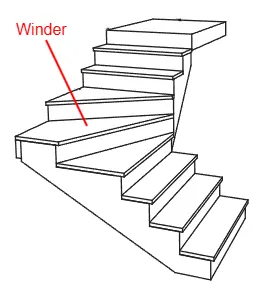
Image from ABCB
Where a house requires stairs keep them simple and generous. Never use winders or spiral stairs to areas you would need to routinely access such as the main bedroom, toilet or shower. There is no way I could have managed a curved stair on crutches. Note the LHDG Silver has no minimum requirement for stairs. Because of this I would recommend specifying any stairs to be at Gold level.
Additional reading
Your Home – The liveable and adaptable home.
Read more about my design process and services.